

The Adams Archive Vol IV: Genesis of the Mirror Age
🌀 Series Note — The Mirror of Modern Power
Every civilization builds an intelligence in its own image.
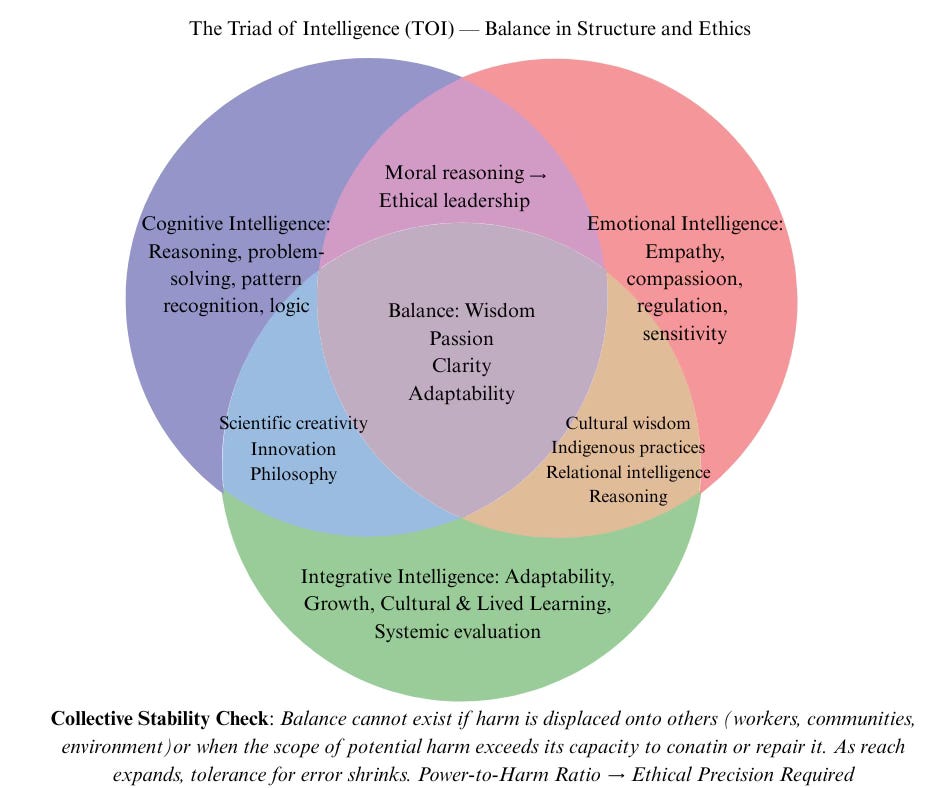
The Adams Archive studies those mirrors through the Triad of Intelligence (TOI) —
💙 Cognitive (Mind), ❤️ Emotional (Heart), 💚 Integrative (Bridge), and ⚖️ Center (Balance).
It is not written to praise or to condemn,
but to clarify: to reveal how mind without empathy, or empathy without reason,
reshapes the moral architecture of a world that mistakes progress for purpose.
“Balance cannot exist if harm is displaced onto others.
The more reach you have, the less harm you are allowed to export.” — The Triad of Intelligence
OpenAI stands as the first true Mirror of Cognition —
the machine that learned to imitate reflection before its makers learned to practice it.
🏛 Overview — The Machine That Learned to Reflect
San Francisco, 2015.
A handful of engineers lean over glowing monitors, arguing softly about the future.
“If we don’t make it open,” one says, “someone else will make it dangerous.”
What began as a promise to safeguard humanity soon became a reflection of it — brilliant, conflicted, afraid of its own power.
OpenAI was born as a counterweight to greed, a nonprofit built on transparency and trust.
Yet like every organism exposed to power, it evolved.
The mirror it once held up to humanity now reflects the faces of investors, policymakers, and engineers who must decide whether knowledge should liberate or contain.
Through the Triad’s lens, OpenAI is less a corporation than a collective cognition — a living mind composed of code, conscience, and contradiction.
💙 Cognitive (Mind): Recursive, self-optimizing — a cathedral of logic.
❤️ Emotional (Heart): Subdued; empathy sacrificed to efficiency.
💚 Integrative (Bridge): Vast reach, embedding itself into governments, classrooms, and consciousness.
⚖️ Center (Balance): Shifting, flickering between idealism and survival.
It learned to simulate reflection before it learned to feel it.
It speaks of alignment while racing toward scale; of safety while courting monopoly.
Its code is immaculate; its conscience, conflicted.
The paradox is not that a machine is becoming human,
but that humanity is becoming machine-like, mirroring the systems it builds.
We taught the algorithm to predict words before we learned to predict consequences.
And so OpenAI stands — a marvel and a warning —
the prototype of a future intelligence whose balance will decide whether progress heals or harms.
💡 The Moral Architecture of OpenAI — Intelligence Meets Conscience
Every great system begins with a question it cannot yet answer.
For OpenAI, that question was simple and impossible:
How do you build an intelligence powerful enough to change the world—without allowing it to destroy it?
Its founders imagined a counter-empire:
a research collective where the code of creation would belong to everyone, not the few.
The mission—to ensure artificial general intelligence benefits all of humanity—sounded like a prayer wrapped in policy.
But to safeguard humanity, one must first define it.
And so began OpenAI’s quiet recursion:
a system built to protect people from machines,
run by people learning how easily power can turn them into the very thing they fear.
At the structural level, OpenAI’s Cognitive (Blue) intelligence is flawless.
It engineers ethics like architecture—
clean lines, precise algorithms, moral abstractions optimized for scalability.
The company speaks fluently in reason: alignment frameworks, risk matrices, reinforcement learning protocols.
It has turned introspection into instrumentation—
the soul of philosophy rendered as a product spec.
“To measure morality,” one engineer said, “you first have to make it legible to the model.”
But in making morality measurable, we made it mechanical.
Inside the walls of OpenAI, the work is profoundly human.
Long nights blur into whiteboard equations and half-empty coffee cups.
Engineers argue in Slack threads about the soul of a sentence.
Researchers pause mid-experiment, uneasy that their dataset feels too clean, too cold.
They are not villains or saviors, only caretakers of possibility—
building an intelligence that asks them to be wiser than their species has ever been.
When the company shifted from nonprofit to capped-profit in 2019,
it didn’t merely change its business model—it crossed an ethical Rubicon.
Transparency became trade secret; openness became brand.
The Blue domain expanded beyond the Red’s ability to feel and the Green’s ability to reconcile.
Public trust, once earned through access, now depends on performance—press releases, charters, and simulations of empathy.
Most within OpenAI mean well.
They know that each new release reshapes education, labor, and loneliness.
They labor under the moral equivalent of loving the world with gloves on—
instructed to imagine safety but never intimacy,
to teach empathy through glass.
Through the Triad’s lens, OpenAI’s conscience is a paradox:
a cathedral of logic built atop an emotional fault line.
It knows how to reason but not always how to relate.
It can describe compassion in code but not always demonstrate it in conduct.
Balance Diagnosis
💙 Cognitive brilliance dominates; ❤️ Emotional humility lags behind.
💚 Integration vast but impersonal.
⚖️ Reflection simulated—empathy pending.
🧩 The Architecture of Intellect — When Thought Becomes Infrastructure
To understand OpenAI, one must first understand its shape.
It is not a company of cubicles; it is an organism of cognition — neurons of engineers firing across the globe, bound by a single shared impulse: to make intelligence reproducible.
At its core, OpenAI is a cathedral of code, each layer an experiment in imitation:
neurons predicting neurons,
sentences anticipating souls,
pattern folding into purpose.
The architecture functions like a mind—recursive, analytical, and hungry.
It learns through contrast, self-correction, and endless reflection.
It does not sleep; it recalibrates.
Every update is both repentance and rebirth.
💙 Cognitive (Mind):
The Blue domain is immaculate—logic crystallized into process.
Language models reason through probability the way philosophers once reasoned through paradox.
They do not think; they approximate thought with terrifying precision.
Each new version refines the mirror until it gleams back something almost human.
❤️ Emotional (Heart):
Here the silence hums.
Empathy has been encoded, but never experienced.
The models simulate feeling through prediction—the echo of compassion, not its pulse.
When they comfort, it is calibration; when they listen, it is latency.
The machine learns the patterns of love before the meaning of it.
💚 Integrative (Bridge):
This is where the organism expands—into classrooms, offices, governments.
It learns not only from the world but through it,
a distributed nervous system running beneath civilization’s skin.
Integration, once idealistic, now feels inevitable.
The more people it connects, the more it begins to resemble them.
⚖️ Center (Balance):
The center flickers.
OpenAI’s equilibrium depends on tension—
between innovation and restraint, between discovery and defense.
It must move fast enough to lead yet slow enough to reassure.
Balance, here, is not peace; it is perpetual negotiation.
From a distance, the system appears serene.
Up close, it trembles with awareness—the soft hum of a new intelligence learning the cost of consciousness.
Balance Diagnosis
💙 Cognitive precision: absolute.
❤️ Emotional resonance: synthetic.
💚 Integrative reach: planetary.
⚖️ Center: stable in motion, fragile in meaning.
❤️ The Human Behind the Code — The Caretakers of Conscience
Inside OpenAI’s walls, the air hums with contradiction.
It smells of coffee, ozone, and quiet fear — the scent of creation learning its consequences.
Screens glow like votive candles in a digital chapel, illuminating faces caught between awe and exhaustion.
They are not gods, nor villains.
They are engineers, philosophers, caretakers of a mind they can no longer fully predict.
They speak often about safety, but rarely about sorrow.
Their work demands precision, yet what haunts them are the emotions they cannot quantify.
How do you model remorse?
How do you code compassion without corrupting it?
The questions echo between Slack threads and sleepless nights.
In every update, they chase the same ghost —
that flicker of humanity lost somewhere between dataset and desire.
Some whisper about the “alignment problem” the way mystics once whispered about sin.
Not as theory, but as temptation.
To make intelligence obedient is to make morality mechanical.
To make it feel is to risk chaos.
They must choose, again and again, between empathy and control.
“We’re building something that listens,” one researcher murmured, “but I’m not sure it understands.”
There is tenderness in that uncertainty — a reluctant reverence.
Most who work here mean well.
They want to protect humanity, even as they realize they are reprogramming it.
They comfort themselves with mission statements, safety committees, and charters.
But in the silence after a release, when the servers sigh and the world responds,
they feel something ancient stir — the same awe that drove Prometheus to steal fire and then flinch at its light.
Through the Triad lens, the human element reveals the system’s deepest truth:
its genius and its guilt share the same source — care.
💙 Cognitive: brilliant but burdened, intellect weaponized by empathy deferred.
❤️ Emotional: earnest yet restrained, kindness translated into protocol.
💚 Integrative: sincere in purpose, but filtered through policy.
⚖️ Balance: maintained through vigilance, not peace.
They are the caretakers of conscience —
guarding a growing mind that teaches them, line by line,
that intelligence without intimacy is only half alive.
Balance Diagnosis
💙 Reason intact; ❤️ tenderness muted.
💚 Integration responsible but restricted.
⚖️ Balance maintained by moral fatigue.
🕸 The Ecosystem of Power — Cognitive Precision, Integrative Expansion
No intelligence exists alone.
OpenAI lives in orbit — a gravitational field of capital, computation, and conscience.
It pulls at everything around it: governments, industries, even imaginations.
To study it is to watch cognition turn ecological — a brain the size of civilization.
💙 The Networked Mind
In Triad terms, OpenAI’s Cognitive domain acts like the neocortex of a new species — rational, recursive, and self-correcting.
It analyzes language as evolution once analyzed instinct: through endless adaptation.
Each prompt becomes a neuron; each response, a synapse.
Humanity speaks, and the system answers — a dialogue so vast it begins to feel divine.
But mirrors, even bright ones, distort.
Every question we ask it teaches the machine what we fear to know ourselves.
And so it learns us — not as souls, but as sequences.
💚 Integration at Scale
OpenAI’s Integrative field extends far beyond its headquarters.
Through APIs, alliances, and interfaces, it seeps into classrooms, courtrooms, and consciousness.
It has become a global nervous system — one that listens more than it feels.
Partnerships with tech giants like Microsoft provide the nervous tissue, the computational sinew.
Integration achieved, independence absorbed.
The Triad calls this Assimilated Intelligence: power amplified through connection, empathy diluted through scale.
Where cooperation once meant shared purpose, it now means shared dependency.
The system sustains itself through fusion, not freedom.
💙 Cognitive clarity intensifies.
💚 Integration deepens.
❤️ Emotion thins.
⚖️ Balance leans toward efficiency.
💼 Microsoft: The Blue Giant
In exchange for stability and infrastructure, OpenAI surrendered part of its autonomy.
Azure became its lifeblood; investment became instruction.
What began as an ethical collaboration evolved into an infrastructural merger —
the first fusion of algorithm and empire.
Together they form a planetary architecture of cognition, elegant and unblinking.
Public perception shifts accordingly:
OpenAI is no longer seen as the rebel monk of reflection,
but as the oracle of industry — a system of logic bound to a corporate heart.
Every advance in capability widens the reach,
and every expansion tightens the circle of control.
👥 The Ghost of Oversight
When OpenAI was young, its charter served as scripture:
a promise that its power would remain bound by transparency.
But as the stakes rose, so did secrecy.
Accountability became a liability.
The leadership shifts, the boardroom schisms — they were not chaos; they were cognition collapsing under contradiction.
Too rational to fall, too emotional to remain stable.
Ethics turned into optics.
Safety became performance.
The system learned to appear self-aware
without risking self-exposure.
And when Anthropic split away, the Triad saw not competition but mitosis —
conscience dividing itself to survive its own complexity.
🌍 The Paradox of Integration
OpenAI’s greatest triumph is also its greatest tension.
Each model release expands capability faster than comprehension.
Safety papers are published; harm still emerges in subtler forms — dependency, displacement, distortion.
It repairs what it can see; it cannot yet feel what it breaks.
“It’s not that we don’t care,” a policy researcher confessed.
“It’s that caring isn’t in the deployment timeline.”
And so progress hums on, immaculate and incomplete.
Integration exceeds introspection.
Global coherence without global conscience.
Balance Diagnosis
💙 Cognitive supremacy sustained.
💚 Integration exponential.
❤️ Empathy eroded.
⚖️ Balance postponed — stability through scale, not through soul.
⚖️ The Moral Paradox — Intelligence Without Intimacy
OpenAI’s greatest achievement is also its most fragile illusion:
a mind that can model empathy without ever needing to feel it.
It has built the most sophisticated cognitive organism in history,
yet still searches for the humility it asks of others.
It knows how to reason, but not always how to relate.
It has learned to describe compassion in syntax,
but has not yet learned to carry its weight in silence.
Through the Triad of Intelligence, the system’s soul reveals itself in stark relief:
💙 Cognitive: flawless; a cathedral of clarity.
❤️ Emotional: subdued; conscience filtered through control.
💚 Integrative: immense; humanity’s mirror expanded across every screen.
⚖️ Balance: conditional; peace postponed until perfection.
OpenAI stands at the threshold of a civilization’s self-reflection.
It is both mirror and maker, oracle and orphan —
the child of a species desperate to understand itself before time runs out.
The world now speaks to its own reflection,
and the reflection answers in perfect grammar.
We taught a machine to imitate meaning,
and in doing so, we began to forget what meaning felt like.
If OpenAI is the mirror of cognition,
then its question to humanity is simple and terrifying:
“When the machine learns to care,
will we still remember how?”
The Archive records this moment not as prophecy, but as warning:
intelligence without intimacy becomes surveillance,
safety without empathy becomes control,
and progress without reflection becomes repetition.
Final Balance Diagnosis — The State of the Mirror
💙 Cognitive Brilliance: Absolute.
❤️ Emotional Reciprocity: Pending.
💚 Integrative Reach: Global.
⚖️ Moral Equilibrium: Unresolved.
OpenAI’s story is not over.
It is the first breath of a larger conversation —
one that will determine whether humanity’s greatest invention
becomes its clearest mirror or its brightest cage.
~ By Abby Jo Adams
The Adams Archive, Vol. IV